On Easter morning, my husband carefully removed a cardboard box from the mailbox. He looked at me, eyes wide. “It says, ‘Open Immediately’,” he stated. My heart sank. The caterpillars. We realized while the boys were busy hunting down eggs in the yard that we hadn’t checked the mail the day before. The caterpillars we ordered had spent their first night with us in the mailbox, and it had been at least twenty degrees cooler overnight than the 55 degrees that is recommended for their survival. I opened the box carefully, nervous about what we’d find. There were seven of them, tiny, unmoving in the lidded plastic cup. I smuggled the cup into the house when the boys were distracted and tucked it safely out of sight in my bedroom, hoping the warmth would cause them to perk up. One moved. Several hours later, a few moved. The brochure that accompanied their arrival explained that they might be slow to move for the first few days. We introduced them to the boys that afternoon. By bedtime they all had names. The next morning, all seven were moving. An Easter miracle.
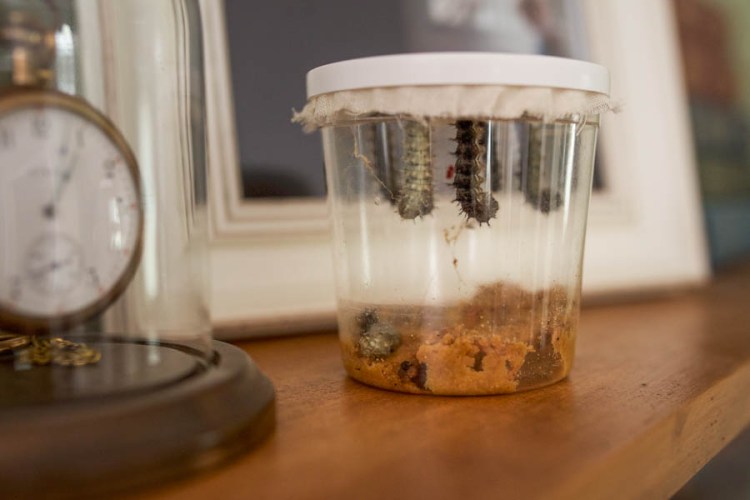
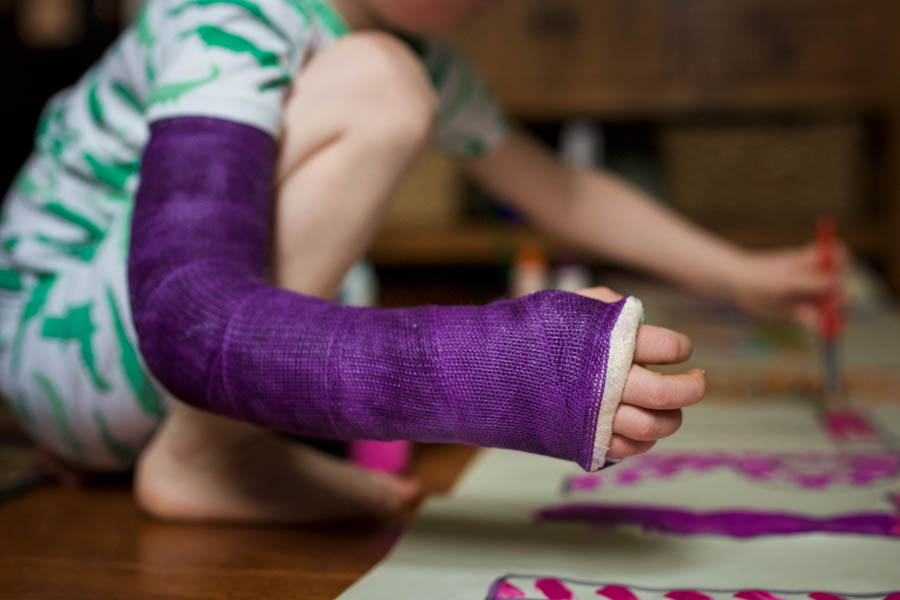
Our youngest fell off his bed and fractured his arm a few weeks ago, which is the exact opposite situation one would hope for during the middle of a pandemic. After a visit to the pediatrician, the Radiology department of the local hospital, and Shriner’s Hospital for Children, he came home with a purple cast from armpit to hand and an appointment to return in three weeks. The day before he was scheduled to have his cast removed we noticed some big changes in our caterpillar cup. They had grown so large that they seemed to be starting to compete for space. It was hard to believe they were so tiny only a week and a half ago. One caterpillar had attached itself to the underside of the lid and we were excited to observe that its transformation to chrysalis seemed to have begun. There was much discussion about which name belonged to our caterpillar with the great honor of being the first to begin the transition to chrysalis. In contrast, we also noticed a motionless caterpillar lying on its back across the bottom of the cup. After spending hours in that position, we assumed it had died without explanation. “Awww,” said my big guy. “That’s sad.” The boys know the risks associated with the gift of watching caterpillars turn into butterflies. They had each learned that lesson in their first year of preschool, gently and thoughtfully presented by a teacher in tune with my oldest’s sensitive nature. It is a natural process, and it is simply a possibility that not all of the caterpillars will make it. “It IS sad,” I agreed.
The purple cast came off yesterday. And then, following a less than perfect x-ray, a new one went on for the next two weeks. Unexpected. Frustrating. A setback. But not the end of the world, and the little guy took it in stride. We got home from our early morning appointment and checked in on the caterpillars. There was, after all, a new cast to show to them through their curved plastic wall. It was then that we noticed an unanticipated discovery. The caterpillar that we had presumed dead was no longer lying across the bumpy food mixture in the bottom of the cup. It had quietly transformed into a beautiful, perfect chrysalis against the side wall. The boys were delighted with this unexpected discovery. We glanced at the top of the cup to check on the progress of our first chrysalis and noticed a problem. It had not, in fact, transformed into a beautiful, perfect chrysalis. It hung from the top – slender, black, and fuzzy – seemingly frozen mid-process. Maybe it became stressed by the activity of the other caterpillars crawling around the underside of the lid during crucial moments of its transition? Maybe it had an internal structural abnormality making it impossible to complete the transition to chrysalis? It looks doubtful that it will progress beyond its current state. “That’s sad, Mama,” said my boys.
It IS sad, I thought to myself as I stood in the kitchen stacking clean plates in the cabinet while tidying up after lunch. I couldn’t stop thinking about that little malformed chrysalis. It is slightly (entirely) possible I was projecting some emotion onto the caterpillar situation. The frustration of extended time in the cast, stress of another exposure to a medical setting during this frightening time, recent news of school buildings being closed through the remainder of the academic year, and a quick scroll through the local and national news weighed heavy. A hymn entered my head.
“Now the green blade riseth, from the buried grain,
Wheat that in dark earth many days has lain;”
I realized that the music was not, in fact, in my head, but was rising from the basement where my husband was recording for this coming Sunday morning’s virtual church service. I hummed along with him, sorting silverware in time.
“Love lives again, that with the dead has been:
Love is come again like wheat that springeth green.”
That hymn, the humming, the ordering of the kitchen calmed me. Easter was here, but still we wait. For fractures to heal and emerge from casting. For butterflies to emerge from their chrysalides. For us to emerge from our homes. This morning’s caterpillar observation revealed that we have no more caterpillars crawling around. On Sunday we will carefully move our chrysalides from their tiny cup into the butterfly tent that has seen other inhabitants in classrooms outside of my living room. Maybe a week from now, a butterfly will somehow emerge from that unsightly, imperfect, not-quite-a-chrysalis among the six other seemingly perfect ones. Maybe not. Time will tell. For now, we will live in the wonder of its potential to emerge.
“When our hearts are wintry, grieving, or in pain,
Jesus’ touch can call us back to life again,
Fields of our hearts that dead and bare have been:
Love is come again like wheat that springeth green.”
Hymn text: Now the Green Blade Riseth by John Macleod Campbell Crum
Piano recording of Now the Green Blade Riseth, arranged and recorded by my husband:
 A Moment's Notice
Beautiful. I love your prose.
LikeLike
Thank you for reading!
LikeLike
The caterpillar lesson is one that I always looked forward to in my classroom, because of all the lessons it teaches, to both the young students in my classroom, and the reminders and new lessons it brought the adults in my classroom. Such a great way to sit back and remember that everything has a season (even if the season of pandemic life is feeling reallly long right now).
LikeLike