
A few weeks ago my two boys played with their cousins for the first time in almost 4 months. My sons had not played with any kids aside from each other since the day they left PreK and 1st grade back in March. They were delighted. The kids chased and caught moths, balanced on river rocks, and surprised themselves with how their swimming skills have improved since last summer. We witnessed a bald eagle flying toward, directly over, and then away from us as it followed the winding path of the river. We celebrated Grandpa’s milestone birthday in person instead of via Zoom, which was how we had celebrated Nonna’s birthday two months prior. It was a good day. It almost felt normal. Except normally I wouldn’t hold my breath for the following two weeks until we knew for sure that it hadn’t been a mistake to share space.
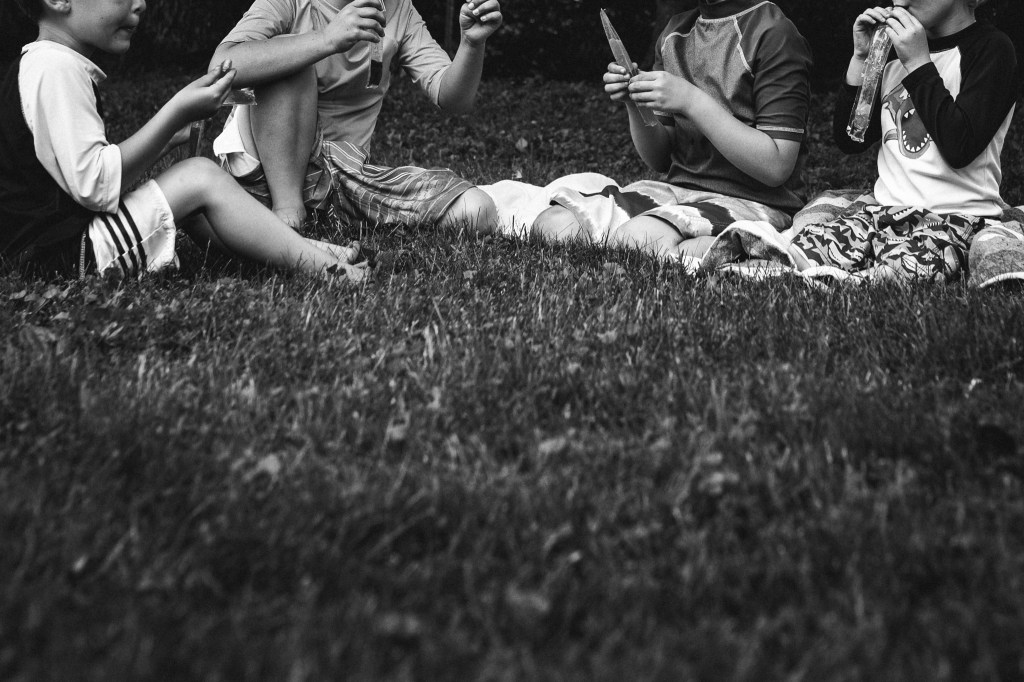
The four boys sat on a blanket with their freeze pops following dinner, swimsuits now dry from their river adventure. There was symmetry in their placement – younger brother, older brother, older brother, younger brother. They laughed and giggled, lips darkening into red, yellow, and pink as the pops disappeared from their plastic casings. “I just got you!” I heard one cousin exclaim. “I got you with a foam ball! Quick, let’s climb up to the next level!” “Ok!’ another cousin agreed. “Let’s go!” Except they didn’t go anywhere, and there was not a foam ball in sight. I paused to listen. “Guys, I’m done playing Billy Beez. Let’s pretend we’re at the New Hampshire house! Let’s pretend to watch a movie of it!” “Yeah!” they all agreed. And without skipping a beat they turned to face the same direction, looking at a movie screen that wasn’t there and continuing their commentary of shared vacation memories as if it were.
One of the instructional strategies I implement in my work with children with Autism Spectrum Disorders is a social story. Social stories are used in a variety of ways and for a variety of reasons, but the gist is that they teach expectations, routines, verbal scripts, and behavioral responses to new and/or challenging situations. A line I was taught to include in many of the social stories I write for kids is, “It’s different, but it’s ok.” And every time I do, I hear in my head the sing-song, higher pitched emphasis on “DIFFERENT” and then the lower pitched strength in “OK” in the voices of my earliest mentors. Sometimes our class practices being safe during a fire drill. It’s different, but it’s ok. Sometimes a baby tooth falls out and a new tooth will grow in. It’s different, but it’s ok. And most recently – We have to wear a mask when we are at a place that is not home. It’s different, but it’s ok. That acknowledgment of the different followed by the encouragement and permission to accept something new can be such a mantra of reassurance, especially for individuals who have a difficult time straying from the familiar, expected routine.
Yesterday my younger son asked when we will be seeing his cousin on my side of the family who lives several states and a 14 hour car ride away. “I know when we’ll see him!” he exclaimed, his face lighting up. “On the 4th of July!” My heart sank. “Well, bud, we USUALLY see him on the 4th of July, but this year is different.” Though we have been talking about not seeing that particular cousin this summer, I realized that his five-year-old concept of time didn’t truly process the implications of what that meant. However the specifics of my family’s 4th of July celebration are well-established. The 4th of July means a visit from my sister and nephew, wine and sparklers from Indiana, and sitting on a blanket under the stars (or umbrellas) on the lawn of Tanglewood while my father sings along with James Taylor. “Well what WILL we do?” he asked. I told him we’d go to his Nana and Pops’ house. “Yeah and what will we DO?” he demanded, not yet satisfied with my response. “Well, we will play with glow sticks. And roast marshmallows. How does that sound?” “Good,” he replied.
Good, I thought.
It’s different, but it’s ok.
And I thought about my boys with their other cousins a few weeks back – sitting with their freeze pops, pretending to be at a play place that has been closed for months, reliving memories of our annual vacation house that we are hoping and praying and crossing our fingers and toes we can still visit later this month. In the moment I saw sadness and the profound emotional impact of the need to social distance and use caution when together. Today I realized that though I was sad for them, THEY weren’t sad. They were happy to finally be together and connect via shared memories and experiences. It was a different way of being together, but they were ok. It’s different, but it’s ok.
There are many things happening in our world and in our individual lives right now that are most decidedly NOT OK. I recognize that and feel it, viscerally. I see the flaws in applying “different but ok”, yet it gave me pause today and was a helpful shift in my thinking. It has been difficult for me to find the line between “irrational anxiety” and “rational caution” as we navigate making the best decisions for our family throughout this summer and into next school year. But as I look at those four cousins playing through a lens of resilience instead of a cloud of worry it does bring a sense of hope. Everything that is beyond our control starts to feel a bit more manageable.
For many people, this summer looks different from what we had originally anticipated. Some people’s “different” is bigger, harder, more heartbreaking than others. But I suspect just about everyone has found themselves facing at least some degree of change or challenge as of late. It’s different, but it’s ok. Or it WILL be ok, eventually. Or maybe it actually ISN’T ok, really, but small glimmers of ok will start to burst through the different if you look for them to be there.
 A Moment's Notice
Thank you, Katie. As always, stirred my heartstrings with your writing. I love your hopefulness at the same time you are acknowledging our current reality. Kids sometimes help us get through the hardest times. You are so amazing at keeping your eyes and ears tuned to your boys.
LikeLike
Thank you, Katie. As always, stirred my heartstrings with your writing. I love your hopefulness at the same time you are acknowledging our current reality. Kids sometimes help us get through the hardest times. You are so amazing at keeping your eyes and ears tuned to your boys.
LikeLike